Local SEO in Columbus, Ohio
When someone in Dublin, Westerville or Grove City searches for what you do, the map pack decides who gets the call. We get you into it — and keep you there.
See where you rank
Takes 30 seconds. No obligation.
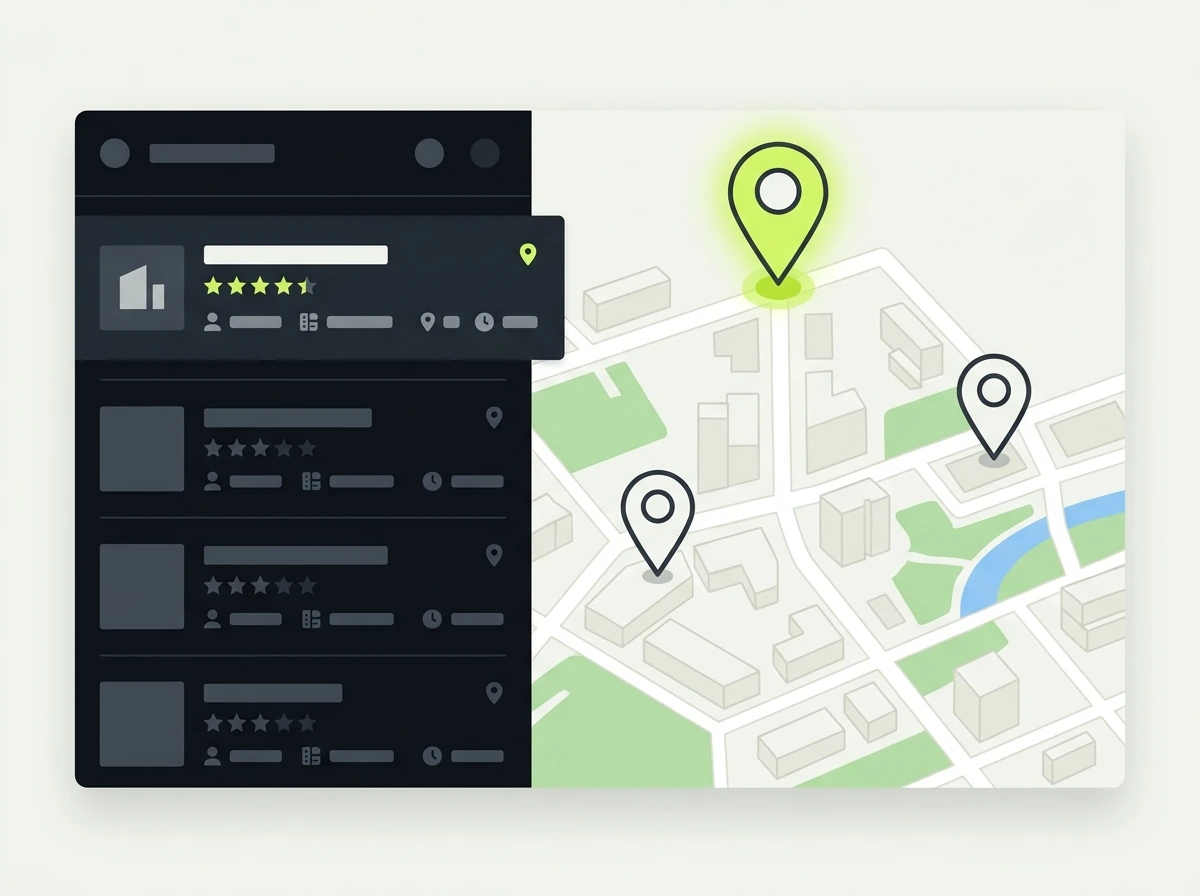
The map pack is the new front door
Roughly half of local-intent searches end in the three-result map pack, and Google builds that pack from proximity, relevance and prominence. That means local SEO isn't one thing — it's your Google Business Profile, your citations, your reviews velocity, your suburb pages and your on-site signals all pulling together.
We run all of it as one system, tuned to how central Ohio actually searches — because ranking in "Columbus" means nothing if you're invisible in the suburb where your customers live.
Get my free audit →Why "ranking in Columbus" isn't good enough anymore
Ten years ago, one well-optimized Columbus page could catch most of the metro's search traffic. That's no longer true. As the region has grown — Dublin, Westerville, New Albany, Hilliard, Grove City and a dozen other suburbs all adding population and businesses — Google has gotten much better at matching searchers to the closest relevant result, not just the biggest website.
In practice, this means a business in Grove City searching for a service will often see different map pack results than the exact same search from Westerville, even though both fall inside "Columbus." If your only local presence is a homepage that mentions Columbus once in the footer, you are invisible to a large share of your actual service area.
The fix isn't complicated, but it is real work: a genuine page for each area you serve, a Google Business Profile that's actively maintained rather than set up once and forgotten, and a steady flow of reviews and citations that tell Google (and your customers) that you're an established, trustworthy local business.
What local SEO includes here
GBP management
Categories, services, photos, posts and Q&A — actively managed, not set-and-forgotten.
Citation cleanup
Consistent NAP across the directories that matter; the junk ones suppressed.
Review strategy
A compliant system for earning steady reviews — and responding like a human.
Suburb pages
Real, substantive pages for Dublin, Hilliard, Grove City — not city-name swaps.
Local schema
LocalBusiness structured data wired correctly across the site.
Rank tracking
Grid-based local rank tracking so you see the map, not just a number.
The numbers behind the map pack
How we build your local rankings, step by step
Local SEO isn't a switch you flip once. It's a repeatable process we run for every Columbus client, in this order.
Audit your local footprint
We check your Google Business Profile, your NAP (name, address, phone number) consistency across directories, and how you currently show up for your top search terms in Columbus and your suburb.
Fix the foundation
Wrong categories, missing services, inconsistent addresses, thin website content — the basics that quietly cap every local ranking get fixed first.
Build local proof
Real suburb pages, review outreach, and citations on directories that actually carry weight in Ohio, not generic filler.
Track and adjust
Grid-based rank tracking shows where you rank across the whole metro, not just one search box — so we can see which suburb needs more work next.
Local SEO and regular SEO are not the same job
| Signal | Regular (organic) SEO | Local SEO |
|---|---|---|
| What ranks it | Content depth, backlinks, site authority | Proximity to searcher, Google Business Profile, reviews |
| Where you show up | Standard blue-link results | Map pack (top 3) plus Google Maps |
| Best for | Ecommerce, national brands, informational content | Any business with a physical location or service area |
| Typical Columbus client | A store shipping nationwide | A dentist, roofer, restaurant or law firm serving one metro |
Most Columbus small businesses need both — but weighted heavily toward local, since that's where your actual customers are searching.
"We don't optimize for 'Columbus.' We optimize for the seven-mile radius where your actual customers live — because that's the only ranking that puts money in your register."— ScarletRank local SEO approach
Why we spend so much time on Google Business Profile
If we had to pick one factor that moves Columbus local rankings more than anything else, it's your Google Business Profile — the free listing that shows your hours, photos, reviews and posts directly in search and maps. Most business owners set it up once at launch and never touch it again, which is exactly why so many map pack spots are winnable.
Google reads an actively maintained profile as a signal that a business is real, open, and trustworthy. That means the categories you choose (primary and secondary), the services you list, the photos you upload, and how quickly you respond to reviews all feed into whether Google shows you before or after the business two blocks away.
We treat this as ongoing work, not a one-time setup: weekly posts about what's happening at your business, monthly photo refreshes, and a standing system for asking every satisfied customer for a review — the single most requested, most effective, and most neglected local SEO task there is.
Citations: the quiet signal most agencies skip
A citation is simply your business name, address and phone number listed on another website — a directory, a chamber of commerce site, an industry association page. They don't look exciting, but they're one of the ways Google cross-checks that your business is real.
Accuracy over volume
Ten accurate citations on directories that matter beat two hundred citations on spam sites nobody visits. We clean up wrong or outdated listings first.
Ohio-relevant directories
Local chambers of commerce, industry associations and Ohio-specific business directories carry more weight for Columbus searches than generic national listing sites.
Consistency, not just presence
The value comes from every listing matching exactly — same suite number, same phone format, same business name — not just from being listed somewhere.
A simple, honest system for earning reviews
Review count and recency are two of the clearest signals Google uses to decide who deserves a map pack spot. Here's the compliant system we run for every client — nothing bought, nothing fake.
Ask at the right moment
The best time to ask for a review is right after a customer says thank you — not three weeks later in a generic email blast they'll ignore.
Make it a one-click path
A direct link straight to your review form removes the friction that stops most happy customers from ever leaving one.
Respond to every single one
Positive or negative, a thoughtful response shows future customers — and Google — that a real person runs this business.
Never buy or fake reviews
Purchased reviews get caught and removed, along with your listing's credibility. It's the fastest way to undo months of legitimate work.
Local SEO mistakes we see most in Columbus
What actually hurts rankings
- Creating duplicate suburb pages that just swap the city name
- Letting the Google Business Profile sit untouched for months
- Buying cheap citations from directories no real customer visits
- Ignoring negative reviews instead of responding professionally
- Using a P.O. box or virtual office address that doesn't match reality
What actually moves the needle
- A real, useful page for every suburb you genuinely serve
- Weekly Google Business Profile posts and fresh photos
- Citations on the handful of directories Ohio customers actually use
- A simple, consistent system for asking happy customers for reviews
- Matching your listed address exactly everywhere it appears online
What local SEO looks like in each part of the metro
"Columbus" covers a lot of very different markets. Here's how the work actually differs by area.
Dublin & Powell
Higher-income, higher-competition suburbs where professional services (dentists, lawyers, financial advisors) fight hardest for the map pack. Review velocity and E-E-A-T signals matter most here.
Hilliard & Grove City
Fast-growing residential areas where new households are actively searching for local services for the first time. Being first to build a genuine suburb page pays off disproportionately.
Westerville & New Albany
Family-oriented markets near the Intel corridor seeing rapid new construction. Local intent here skews toward home services, healthcare and schools-adjacent businesses.
Short North & German Village
Dense, walkable, tourism-adjacent neighborhoods where restaurant and retail SEO depends heavily on photos, reviews and foot-traffic signals rather than pure keyword volume.
Reynoldsburg & Pickerington
East-side growth corridors where local competition is lighter today but increasing fast — the suburbs where ranking early is cheapest.
Downtown Columbus
B2B and professional services compete on organic authority as much as local proximity, since many searchers here are researching rather than walking distance away.
A realistic local SEO timeline for a Columbus business
Anyone promising instant map pack rankings is selling something. Here is what actually happens, month by month, for a typical local client.
Weeks 1–2: We complete the audit, clean up your Google Business Profile categories and services, and fix any NAP mismatches we find across directories. This is unglamorous but it removes the ceiling that was quietly capping your rankings.
Month 1–2: New suburb pages go live, citation cleanup finishes, and your review outreach system starts running. You'll usually see small movement — a few keywords entering page one, more profile views — but nothing dramatic yet.
Month 3–4: This is typically when map pack movement becomes visible for less competitive terms, especially in growing suburbs like Hilliard or Grove City where competition is lighter. More established markets like Dublin usually take longer.
Month 6+: Established local businesses following the process consistently tend to see steady, compounding results — more map pack appearances, more calls, more foot traffic — because local SEO rewards consistency more than any single tactic.
The honest caveat: your specific timeline depends entirely on how much competition exists for your service and suburb today. A dentist in an underserved suburb moves faster than a personal-injury lawyer downtown competing against a dozen well-funded firms.
Local ranking factors we monitor every month
Ranking algorithms shift constantly, but these ten factors have stayed consistently important across every Columbus campaign we've run. We report movement on all of them every month, not just a single ranking number.
Common questions
How is local SEO different from regular SEO?
Local SEO targets geographic intent — map pack and 'near me' results — where proximity and your Google Business Profile matter as much as your website. Regular SEO is the broader organic game. Most Columbus businesses need both, weighted toward local.
Can you guarantee map pack rankings?
No one honestly can — Google factors proximity per-searcher. What we can do is maximize every controllable signal, which is why our clients show up far more often across the metro grid.
Do I need separate pages for each suburb?
If you serve multiple suburbs, yes — but they must be genuinely different pages. Google ignores (and can penalize) find-and-replace city pages. Ours carry real local substance.
What is NAP consistency and why does it matter?
NAP means your business Name, Address and Phone number. When these details match exactly across your website, Google Business Profile, and every directory that lists you, Google trusts that you're a real, stable business. Mismatched details — an old suite number here, a missing "Ohio" there — quietly hold back your rankings.
How is local SEO different for a single location vs. a service-area business?
A single-location business (a restaurant, a dental office) optimizes around one physical address. A service-area business (a roofer, an HVAC company) instead builds authority for every suburb it actually serves, since customers search by their own city, not yours.
Does my Google Business Profile matter more than my website?
For local, "near me" searches, yes — often the map pack loads before a searcher ever clicks through to a website. But your website still needs real substance, because Google checks that your site backs up what your profile claims.
How many reviews do I need to compete?
There's no fixed number — what matters is staying ahead of your direct competitors and keeping a steady, recent flow rather than one burst of reviews followed by silence.
What if I already have negative reviews?
A handful of honest negative reviews, especially with a professional response from you, actually reads as more trustworthy than a suspiciously perfect five-star record.
Is local SEO in Columbus worth paying for, or can I do it myself?
Plenty of it you can do yourself — claiming and fully completing your Google Business Profile, choosing the right primary category, adding real photos and asking customers for reviews gets a lot of businesses most of the way there. What's genuinely hard to DIY is citation cleanup at scale, technical fixes, and knowing which of the twenty things you could do this month actually moves you. If you have time and no budget, start with the profile.
What's the honest, reddit-style answer on choosing a Columbus SEO agency?
The questions people ask in Columbus business groups and on Reddit are usually better than the ones on agency websites: why does every quote differ (because "local SEO" isn't one defined deliverable — ask for an itemized monthly list), how long before results show (profile and review work moves in weeks, content and authority work takes months), and what's the sign you're being ripped off (reports full of impressions with no mention of calls or form fills, annual contracts, and guaranteed rankings — the map pack is calculated per searcher, so a guarantee is a promise about something nobody controls).
Ready to rank in Columbus?
Start with a free plain-English audit — see exactly what's holding you back before you spend a dollar. This is the kind of detail that separates a genuinely local page from a template with the city name swapped in. It is also exactly what the free audit checks first, because it is usually the fastest thing to fix. None of this requires a bigger budget so much as it requires someone actually doing the work every month. That distinction matters more in Columbus than in most metros, given how fast the suburbs are changing. We would rather show you the evidence than ask you to take our word for it.
Get My Free SEO AuditStraight from the source: see how Google ranks local results — the official ranking factors behind the map pack.